I'm sure I'm not the only person who laughed when they heard Sarah Palin say she was going to work to defeat House Speaker Paul Ryan in the Republican primary in August. They say that "pride goeth before a fall" and no one is more prideful than Sarah Palin--who continues to somehow ignore the fact that she is a nobody in politics today--and wields no influence whatsoever.
Palin's "announcement" that she was jumping on the Paul Nehlen bandwagon was typical for her. She talked about what a great guy Nehlen was--and then admitted that she had never actually talked to the guy. She didn't even know if Nehlen actually wants her support. Palin likely heard somewhere that Paul Ryan had a "Tea Party" opponent in the primary and just assumed that he was worth backing--sight unseen. Although someone who has challenged Ryan to forgo the usual debates and instead just have an arm-wrestling match, sounds like someone who thinks the same way as Sarah Palin.
And then over the weekend, the Trump-Palin supporters got great "news" when a poll appeared to show Nehlen with a lead over Ryan among Republicans in the 1st District. All over my Twitter feed and Facebook wall were people trumpeting "See? Look at what Sarah Palin is doing to Paul Ryan!!" The only problem is that poll was completely made up by a website--prntly.com--that posts fake poll numbers all the time--always in support of Donald Trump. And then, Trump himself gives the site "credibility" by Tweeting the results of the fake polls in capital letter and posting a link so you "see for yourself" how great he is doing.
The average Donald Trump/Sarah Palin supporter doesn't care that prntly.com is marketing front for the Trump campaign and that the numbers they are being fed as "proof" of their popularity is fake. If it's on the internet and the Donald says its real, it's real! I guess they can all be shocked when Ryan gets 75% of the vote in the primary (although Democrats crossing over could certainly skew the numbers slightly in August). And imagine their surprise when Trump's own fake poll numbers end up about 30% off in his crushing defeat to Hillary Clinton and November--which ironically enough establishes Paul Ryan as the undisputed head of the Republican Party heading into a much brighter future--where the Sarah Palin's of the world are finally marginalized and ignored.
Tuesday, May 10, 2016


Monday, May 9, 2016
Lessons Learned
As with all tragedies, there are lessons to be learned in the aftermath of the Neenah hostage shooting incident last December. We heard a lot things we already knew in Attorney Brad Schimel's press conference last Friday--including "officers were just following their training" and that "no jury would have convicted them" of acting negligently in shooting one of the hostages instead of the hostage-taker.
But there were some new elements revealed on Friday that the rest of us should all keep in mind--especially if we ever find ourselves in the same situation. For starters, if you have a Carry Concealed Weapon permit, you should probably use your gun as soon as you can. In one of the 911 calls from Eagle Nation Cycles, the owner tells the dispatcher that the eventual shooting victim has a CCW but "must not have his gun, or this would be over already". On surveillance video you see several instances where the hostage-taker is distracted (especially by police attempting to storm the building while he opens fire on them) but the armed hostage takes no action. In fact, the only time he is seen drawing his weapon is while he is trying to escape into a back alley--where he is shot once by the suspect and eight times by the police.
Which leads to lesson learned number two: If you have a Carry Concealed Weapon permit, you want to get rid of your gun the second the police show up or they will shoot you. Neenah Police Chief Kevin Wilkinson was asked Friday what the victim should have done to avoid being shot and initially tried to dance around an answer--saying it would be "disrespectful". But after finally being pinned down to offer advice to anyone else who may be in the same situation some day, Wilkinson could only offer up "Show us your hands"--because if those hands have a gun in them, shots are likely heading your way.
Which leads us to our third lesson learned: Police don't have to identify their target. If they are only looking at your hands, how do they know who you are? Anyone who has ever taken a Hunter Safety Course is told repeatedly: "Know your target and what is beyond it before you pull the trigger". That doesn't apply to those using deadly force on our streets. Although to be fair, there is little possibility of animals and waterfowl firing back at you in your blind.
Once again on Friday we were assured by officials that "the lessons of this tragedy will be learned" so as to ensure it never happens again. Hopefully the rest of us learn the lessons I just mentioned to avoid being the next "tragic victim". Although, there will be more "lessons to learn" after the next incident too.
But there were some new elements revealed on Friday that the rest of us should all keep in mind--especially if we ever find ourselves in the same situation. For starters, if you have a Carry Concealed Weapon permit, you should probably use your gun as soon as you can. In one of the 911 calls from Eagle Nation Cycles, the owner tells the dispatcher that the eventual shooting victim has a CCW but "must not have his gun, or this would be over already". On surveillance video you see several instances where the hostage-taker is distracted (especially by police attempting to storm the building while he opens fire on them) but the armed hostage takes no action. In fact, the only time he is seen drawing his weapon is while he is trying to escape into a back alley--where he is shot once by the suspect and eight times by the police.
Which leads to lesson learned number two: If you have a Carry Concealed Weapon permit, you want to get rid of your gun the second the police show up or they will shoot you. Neenah Police Chief Kevin Wilkinson was asked Friday what the victim should have done to avoid being shot and initially tried to dance around an answer--saying it would be "disrespectful". But after finally being pinned down to offer advice to anyone else who may be in the same situation some day, Wilkinson could only offer up "Show us your hands"--because if those hands have a gun in them, shots are likely heading your way.
Which leads us to our third lesson learned: Police don't have to identify their target. If they are only looking at your hands, how do they know who you are? Anyone who has ever taken a Hunter Safety Course is told repeatedly: "Know your target and what is beyond it before you pull the trigger". That doesn't apply to those using deadly force on our streets. Although to be fair, there is little possibility of animals and waterfowl firing back at you in your blind.
Once again on Friday we were assured by officials that "the lessons of this tragedy will be learned" so as to ensure it never happens again. Hopefully the rest of us learn the lessons I just mentioned to avoid being the next "tragic victim". Although, there will be more "lessons to learn" after the next incident too.
Friday, May 6, 2016
Take Your Parents To Work Day
For the first time in 18-years of broadcasting, my Mother is coming to see me at work today. She will be joining us later this morning to pick the winner of the Aegis Financial WOSH 75th Anniversary Mother's Day Spa Package Giveaway. In anticipation of her visit, the Newsroom is the cleanest it has been in 15-years.
I know we've had my Mother on the air over the phone once or twice before. It might have been for my 30th or 40th birthdays--I can't remember. It would actually be kind of fun to have her on more often--sort of like David Letterman used to have his mother Dorothy on every few months. She could tell embarrassing stories from when I was a kid and then appear to be clueless as to the pop culture events going on in society.
In a way, I'm lucky to have the job I have. When she lived in Green Bay my Mom could listen to me in the morning while driving to work. She could still listen in Eagle River or Florida over the internet--but that would require mastering the actual working of her tablet computer and installing the 1490 WOSH app--and she doesn't like having apps on her tablet. She also reads the My Two Cents Blog on a daily basis--although she admits she's not exactly sure what I'm talking about some of the time. She likes the non-political rants and raves better.
My Dad will be along with my Mother today in studio--but don't expect to hear from him. He is a man of few words and less attention. I definitely got my personality and sense of humor from Mom (along with the premature gray hair). I doubt Bob Burnell will get more than three words out of Bob Krause if he tries to get him on the air this morning.
So hopefully you'll tune back in at 8:15 this morning to hear from my Mom--and to find out whose to blame for me.
I know we've had my Mother on the air over the phone once or twice before. It might have been for my 30th or 40th birthdays--I can't remember. It would actually be kind of fun to have her on more often--sort of like David Letterman used to have his mother Dorothy on every few months. She could tell embarrassing stories from when I was a kid and then appear to be clueless as to the pop culture events going on in society.
In a way, I'm lucky to have the job I have. When she lived in Green Bay my Mom could listen to me in the morning while driving to work. She could still listen in Eagle River or Florida over the internet--but that would require mastering the actual working of her tablet computer and installing the 1490 WOSH app--and she doesn't like having apps on her tablet. She also reads the My Two Cents Blog on a daily basis--although she admits she's not exactly sure what I'm talking about some of the time. She likes the non-political rants and raves better.
My Dad will be along with my Mother today in studio--but don't expect to hear from him. He is a man of few words and less attention. I definitely got my personality and sense of humor from Mom (along with the premature gray hair). I doubt Bob Burnell will get more than three words out of Bob Krause if he tries to get him on the air this morning.
So hopefully you'll tune back in at 8:15 this morning to hear from my Mom--and to find out whose to blame for me.
Thursday, May 5, 2016
Everyone's Drug Money
Have you ever wondered how much of your money has gone to purchase illegal drugs? I got to thinking about this yesterday when Governor Scott Walker authorized drug testing for Unemployment benefit recipients. I'm sure some percentage of the tax dollars we pay to Madison and Washington ends up in drug dealers' hands--but what about the money we spend in everyday situations--how much of that is going to get someone high?
If you give to the many panhandlers that will be popping up all over the Fox Valley now that warmer weather is back, likely every penny of that is going to buy drugs. You can try to tell yourself that you're sure that "homeless veteran" is really using it to buy food and pay rent--but deep down you know, that guy is actually just a junkie. (Or at the very least, if the money is used to buy something else--that just leaves more money from another source to buy drugs).
If you are a parent, some of the cash you give to your teens and college students may end up with the "cool kid" who can score a little weed or some pills on Friday night. The speculation surrounding the death of Prince last month can lead one to assume that some percentage of that $1.29 ITunes download is going to a drug cartel somewhere. And what about what you paid for those beers in the bar, the tips you left at the restaurant and the couple hundred bucks you laid out for that really cool tattoo of your future ex-wife's name that you will someday be paying someone else to remove from your skin? Heck, some of the money Grandma is paying to stay in the nursing home is going to someone stealing her pills to support his or her own addiction.
Conversely, think about how much of the money you make may have come from the sale of illegal drugs. Dealers and traffickers have to eat and buy gas too. I would think the auto shops that specialize in ultra-dark window tinting and chrome wheel installation almost have to assume that's where the customer cash is coming from by now, right? I'd put gun shops on this list too--but thanks to gun control laws, weapons used in the commission of illegal drug crimes are all just stolen nowadays.
You probably want to go wash your hands now, thinking about where the cash you touched today may have been as recently as a few days ago.
If you give to the many panhandlers that will be popping up all over the Fox Valley now that warmer weather is back, likely every penny of that is going to buy drugs. You can try to tell yourself that you're sure that "homeless veteran" is really using it to buy food and pay rent--but deep down you know, that guy is actually just a junkie. (Or at the very least, if the money is used to buy something else--that just leaves more money from another source to buy drugs).
If you are a parent, some of the cash you give to your teens and college students may end up with the "cool kid" who can score a little weed or some pills on Friday night. The speculation surrounding the death of Prince last month can lead one to assume that some percentage of that $1.29 ITunes download is going to a drug cartel somewhere. And what about what you paid for those beers in the bar, the tips you left at the restaurant and the couple hundred bucks you laid out for that really cool tattoo of your future ex-wife's name that you will someday be paying someone else to remove from your skin? Heck, some of the money Grandma is paying to stay in the nursing home is going to someone stealing her pills to support his or her own addiction.
Conversely, think about how much of the money you make may have come from the sale of illegal drugs. Dealers and traffickers have to eat and buy gas too. I would think the auto shops that specialize in ultra-dark window tinting and chrome wheel installation almost have to assume that's where the customer cash is coming from by now, right? I'd put gun shops on this list too--but thanks to gun control laws, weapons used in the commission of illegal drug crimes are all just stolen nowadays.
You probably want to go wash your hands now, thinking about where the cash you touched today may have been as recently as a few days ago.
Wednesday, May 4, 2016
Correcting the Historical Record
I've mentioned here before my abhorrence of revisionist history. It is becoming more common to elevate minor characters in the development of the American nation to some sort of "major figure" status in an effort to appeal to all demographics and modern minority groups. And then you have the application of today's social mores to historical events and decisions in an effort to create a "right side of history" and a "wrong side of history". But sometimes you need to revise historical record in order to correct actual factual errors.
That may be the case for one of the most famous images in American history: the raising of the flag on Iwo Jima.
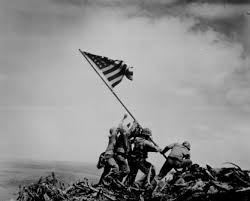
Since 1945, it was believed that Appleton resident John Bradley--who was a Navy Medical Corpsman--was one of the six men pictured in this Pulitzer Prize winning photo. But now, two historians believe the man credited as being Bradley was actually a different Marine--because the clothes worn by Bradley in this photo are slightly different from those worn by him in other pictures taken that same day.
Like many events in history, the details of the Iwo Jima flag raising are...messy. The iconic picture taken by Joe Rosenthal was actually the second flag raising on Mount Surabachi that day. Another one had taken place a few hours before involving a few different Marines--and including John Bradley again:

That may be the case for one of the most famous images in American history: the raising of the flag on Iwo Jima.
Since 1945, it was believed that Appleton resident John Bradley--who was a Navy Medical Corpsman--was one of the six men pictured in this Pulitzer Prize winning photo. But now, two historians believe the man credited as being Bradley was actually a different Marine--because the clothes worn by Bradley in this photo are slightly different from those worn by him in other pictures taken that same day.
Like many events in history, the details of the Iwo Jima flag raising are...messy. The iconic picture taken by Joe Rosenthal was actually the second flag raising on Mount Surabachi that day. Another one had taken place a few hours before involving a few different Marines--and including John Bradley again:

One of the commanders in the battle wanted a bigger flag on the pole, so a company of Marines went up the hill--took down the first flag--and raised the second--which was captured in the famous photo.
Now, the Marine Corps will now review the pictures from that day again and decide if John Bradley retains the honor of being credited as one of the second flag raisers--as well as one of the first.
If the historical record is changed to reflect that Bradley was not involved in the second flag raising does that make him any less of an American hero? Raising the flag one or two times was probably the least heroic thing John Bradley did on Iwo Jima. He was awarded the Navy Cross for entering enemy fire to drag out injured Marines at the foot of the mountain and get them medical treatment the same day as the flag raising. He also received the Purple Heart for wounds suffered when a mortar round exploded near him and other Corpsmen a few days after the flag raisings.
And while Bradley may have mistakenly been included in the publicity (or some would say propaganda) tour following Iwo Jima, he helped raise $27-BILLION in war bond sales--which allowed the troops that continued to fight to have enough guns and ammunition, new ships, new airplanes, bombs, food and medical care to win the war on both fronts. And to his credit, he never personally cashed in on what certainly could have been a very lucrative story-telling career.
To me, it doesn't matter if John Bradley was in both flag raisings, in just the first one or maybe not in either of them. It doesn't change the fact that he was one of the finest examples of what it means to be an American.
Tuesday, May 3, 2016
Tardius, Inferior, Debelior
Faced with an increasing number of student-athletes failing their courses and unable to play sports, the Madison School District has taken bold action to rectify the situation. Did they set up special study halls for failing athletes? No. Did the teacher-coaches work with their kids to help them with the subjects in which they are struggling? No. Did they establish peer-driven tutoring where academically successful student-athletes help their teammates and serve as accountability partners? No. What the Madison School District decided to do was lower the bar for eligibility.
Until now if a student-athlete was failing three course (THREE!!) they were no longer allowed to practice with their team. (Fortunately, the WIAA does not allow any students with ANY failing grades to play in games--however, continued practice can occur if that is a school policy.) When a growing number of kids couldn't meet that eligibility threshold, officials decided to basically do away with any failure limits and allow kids to continue to practice with the team--no matter how poorly they are doing in the classroom.
Supporters of the change do have a convoluted logic for this. They believe that by allowing failing kids to continue to at least practice with the team it will give them the motivation to improve their grades at least to the point where they can once again play in games. They also argue that being in sports provides those kids with some structure in their lives. Studies are rolled out as well showing that participation in sports also leads to higher graduation rates for "at-risk" students.
For starters, the higher graduation rates are due in large part to the fact that there are MINIMUM REQUIREMENTS FOR PASSING YOUR CLASSES TO PLAY SPORTS!! (This is the same flawed logic that gave us the "people with bachelors degrees earn a million dollars more over their lifetime--so let's give everyone a bachelors degree"--even though the reason people with degree made more is because not everyone had one.) What's more, how does that make the kids who are actually putting in the effort to pass their classes feel about that effort? "Gee, I'm doing my homework as soon as I get home from practice while he's playing video games and texting girls all night and he still gets to be a part of the team?"
And remember, this is Madison we are talking about--where the principals of Progressivism and Liberalism are practiced to their fullest extent in all facets of life--and the best thing that can be offered to as much as 5% of the student body is "just keep showing up to school so you can practice with the basketball or football team?"
It's a shame that the tractor has replaced beasts of burden in modern agriculture--otherwise we could send a farmer to the next Madison School Board meeting to tell members what happens with a mule when you take the carrot off the stick and just give it to him for not doing anything.
Until now if a student-athlete was failing three course (THREE!!) they were no longer allowed to practice with their team. (Fortunately, the WIAA does not allow any students with ANY failing grades to play in games--however, continued practice can occur if that is a school policy.) When a growing number of kids couldn't meet that eligibility threshold, officials decided to basically do away with any failure limits and allow kids to continue to practice with the team--no matter how poorly they are doing in the classroom.
Supporters of the change do have a convoluted logic for this. They believe that by allowing failing kids to continue to at least practice with the team it will give them the motivation to improve their grades at least to the point where they can once again play in games. They also argue that being in sports provides those kids with some structure in their lives. Studies are rolled out as well showing that participation in sports also leads to higher graduation rates for "at-risk" students.
For starters, the higher graduation rates are due in large part to the fact that there are MINIMUM REQUIREMENTS FOR PASSING YOUR CLASSES TO PLAY SPORTS!! (This is the same flawed logic that gave us the "people with bachelors degrees earn a million dollars more over their lifetime--so let's give everyone a bachelors degree"--even though the reason people with degree made more is because not everyone had one.) What's more, how does that make the kids who are actually putting in the effort to pass their classes feel about that effort? "Gee, I'm doing my homework as soon as I get home from practice while he's playing video games and texting girls all night and he still gets to be a part of the team?"
And remember, this is Madison we are talking about--where the principals of Progressivism and Liberalism are practiced to their fullest extent in all facets of life--and the best thing that can be offered to as much as 5% of the student body is "just keep showing up to school so you can practice with the basketball or football team?"
It's a shame that the tractor has replaced beasts of burden in modern agriculture--otherwise we could send a farmer to the next Madison School Board meeting to tell members what happens with a mule when you take the carrot off the stick and just give it to him for not doing anything.
Monday, May 2, 2016
Throwing It All Away
On Friday night, Miami Marlins pitcher Adam Conley had a no-hitter going against the Brewers at Miller park into the 8th inning when he was removed from the game by his manager Don Mattingly because he his "pitch count was too high". Conley had thrown 116-pitches with one out in the 8th. A couple of relievers came in after that--not only giving up a hit--but giving up three runs in the 9th to make it much closer than it needed to be.
This was the second time this year that a pitcher with a no-hitter was lifted from a game. LA Dodgers manager Dave Roberts removed Ross Stipling from a no-hitter in the 8th inning against the San Francisco Giants earlier this month due to "too high a pitch count". He had thrown exactly 100-pitches. The next batter hit a game-tying home run off the reliever brought in to save the no-no.
Managers and pitching coaches that live and die by pitch counts nowadays are like global warming alarmists. The don't seem to know what going past their "numbers" would actually mean--and anyone who suggests exceeding those "limits" is scolded for wanting to "destroy the game". Pitch counts have become such an important part of the game that telecasts now have them posted in the corner of the screen at all times along with the count and the score.
It wasn't always like this. Nolan Ryan once threw 235-pitches in a 14-inning loss to Luis Tiant--who threw a complete game with 195-pitches. Juan Marichal and Warren Spahn of the Milwaukee Braves both went the distance in a 16-inning game--throwing 227 and 201 pitches respectively. Oh, and Spahn was 42-years old at the time.
Pitch counts start early now in baseball. Kids in Little League are limited to 75-pitches a game and a certain number per week or weekend tournament. The argument for that is "it saves their arms". Yet, the majority of young pitchers in the Major Leagues today have already had Tommy John surgery to repair torn tendons in their pitching arms. Some baseball insiders have even called it a "step in their careers" and how you "want to get it out of the way as soon as possible".
There is a vocal (but growing) minority that believes kids should be encouraged to throw MORE at younger ages to build up better arm endurance. The key is to not throw every pitch at absolute maximum velocity. Pitching today is a power game--with starters throwing 95-miles an hour going six-innings (due to pitch counts) relieved by bullpen guys throwing 97 in the 7th and 8th and a closer who can hit 100. Mix in a lot more off-speed stuff and well-placed breaking balls, and pitchers would have no problem going more than 100-pitches without looking into the dugout for the manager to come and get them.
Next, let's debunk the "Tony LaRussa Legacy" that your closer can only come in at the start of the 9th inning with no runners on base........
This was the second time this year that a pitcher with a no-hitter was lifted from a game. LA Dodgers manager Dave Roberts removed Ross Stipling from a no-hitter in the 8th inning against the San Francisco Giants earlier this month due to "too high a pitch count". He had thrown exactly 100-pitches. The next batter hit a game-tying home run off the reliever brought in to save the no-no.
Managers and pitching coaches that live and die by pitch counts nowadays are like global warming alarmists. The don't seem to know what going past their "numbers" would actually mean--and anyone who suggests exceeding those "limits" is scolded for wanting to "destroy the game". Pitch counts have become such an important part of the game that telecasts now have them posted in the corner of the screen at all times along with the count and the score.
It wasn't always like this. Nolan Ryan once threw 235-pitches in a 14-inning loss to Luis Tiant--who threw a complete game with 195-pitches. Juan Marichal and Warren Spahn of the Milwaukee Braves both went the distance in a 16-inning game--throwing 227 and 201 pitches respectively. Oh, and Spahn was 42-years old at the time.
Pitch counts start early now in baseball. Kids in Little League are limited to 75-pitches a game and a certain number per week or weekend tournament. The argument for that is "it saves their arms". Yet, the majority of young pitchers in the Major Leagues today have already had Tommy John surgery to repair torn tendons in their pitching arms. Some baseball insiders have even called it a "step in their careers" and how you "want to get it out of the way as soon as possible".
There is a vocal (but growing) minority that believes kids should be encouraged to throw MORE at younger ages to build up better arm endurance. The key is to not throw every pitch at absolute maximum velocity. Pitching today is a power game--with starters throwing 95-miles an hour going six-innings (due to pitch counts) relieved by bullpen guys throwing 97 in the 7th and 8th and a closer who can hit 100. Mix in a lot more off-speed stuff and well-placed breaking balls, and pitchers would have no problem going more than 100-pitches without looking into the dugout for the manager to come and get them.
Next, let's debunk the "Tony LaRussa Legacy" that your closer can only come in at the start of the 9th inning with no runners on base........
Subscribe to:
Posts (Atom)